WeMarket încheie anul cu rezultate record și investește în viitor
WeMarket a încheiat 2024 cu cel mai mare profit brut din istorie și un rezultat financiar de 3,1 milioane.
Find out if you are missing out on potential sales on Facebook and discover tips to optimise your presence to increase conversions.

If you are using lookalike audiences on Facebook, you may actually be shutting down potential sales on the platform.
When you work with lookalike audiences on Facebook, you are effectively narrowing your target group. Facebook is actually better than either YOU or ME at targeting ads based on both your campaign type and the goals you have set for your Facebook campaigns.
Here you will find concrete tips on how to scale your sales on Facebook both with and without using lookalike audiences, and guidance on how to test lookalike audiences against cold audiences.
Lookalike audiences on Facebook are groups that resemble the people who are ALREADY in your audience. These allow you to narrow down your targeting in terms of the number of people who will see your ads.
You can create lookalike audiences on Facebook ranging in size from 1-10%, which are similar to your existing audiences.
Your existing audiences might include:
For example, if you sell women’s shoes, you can create a lookalike audience based on previous buyers in your webshop.
You set up a lookalike audience in Facebook under Audiences > check the audience you want to copy > select audience location (country) > choose audience size
For example, a 1-10% lookalike audience can give you a group of up to 433,200 people in Denmark.
Below is an example of a 0-1% Facebook lookalike audience, which matches all visitors from the last 60 days

Because! If you only advertise to a 1% lookalike audience, you are NOT reaching all the other potential buyers in that country – and there are many. They could potentially be within the remaining 99%.
Because! Facebook’s algorithm may not function optimally during the learning phase (read about the Facebook learning phase here)
And! Your audience becomes exhausted (because it is too small) and the frequency of ads shown to each person rises (making each sale more expensive).
And! You do not know whether a 1% lookalike audience converts better than a 2% lookalike audience.
And! You also do not know whether a “cold” audience performs better than lookalike audiences.
You should try letting Facebook manage the ad delivery, focusing less on the audience and letting the AD CONTENT determine your SUCCESS.
This means you now test your ad content against different audiences, rather than testing audiences against your ad content (as has traditionally been the case). The traditional approach (still used by some) is to select specific demographics and interests for your audience and design a specific ad for them. This is very time consuming (and costly).
Because: Facebook knows BETTER than both YOU and ME who should see your ads (and with which message), based on the campaign objective you have selected 👇

Example of choosing a Facebook campaign objective
Isn’t there a “but…”?
Of course there is – as with almost everything in online marketing. It might work, it might not. But if you do not test, you risk missing out on leads or sales by limiting yourself (and Facebook) with lookalike audiences.
Therefore!
You need to work MUCH more with your ad content, try to focus less on the audience, and let Facebook do the heavy lifting. Facebook’s algorithm is very good at delivering ads to the right people.
And!
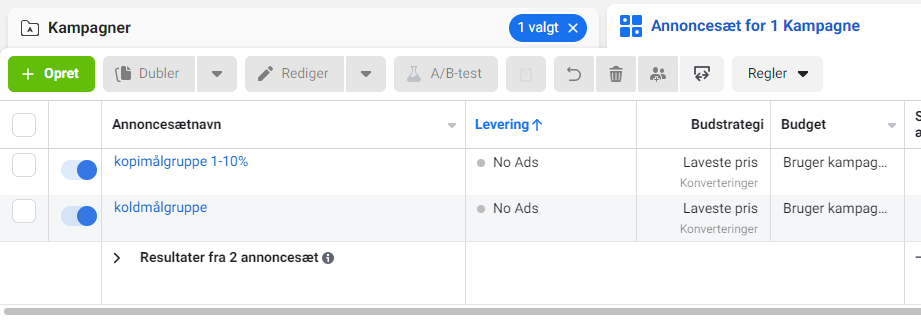
You should try split testing lookalike audiences against a “cold” audience.

Facebook knows your previous visitors and buyers, and these will automatically be included in an “empty” audience. Therefore, Facebook will try to show ads to these people first, as they are closer to making a purchase, which means an “empty” audience will not work as intended. Remember to exclude previous visitors and your newsletter subscribers, for example.


At WeMarket, we offer businesses a benchmark report that compares their marketing efforts with their key competitors. You decide which competitors we should compare against.
We specialise in selling physical goods online and growing webshops – and now you can benefit from this expertise, even if you’re not already a client.
It’s completely free.